Background
Mengniu is a publicly listed dairy leader in Asia, with products spanning liquid milk, ice cream, milk powder and cheese. It has around 38,000 employees and tens of thousands of frontline sales staff working across a multi-tier channel, from major cities to small towns. Its channel business is organized into four business units (BUs): ambient, low-temperature, fresh milk and overseas. Each BU has its own distributors, retail network and sales targets, yet they share many of the same distributors and stores.
That structure is the challenge this three-year partnership set out to solve: how can a group give every BU the autonomy to run its own channel, while keeping one standard, one set of data and one view of the market at group level?
The Challenge
Mengniu's earlier marketing systems, including its first- and second-generation platforms and a separate trade promotion management (TPM) tool, had digitized core channel operations. As the business grew, three gaps appeared:
- • ⊗ Disconnected systems. Master data, orders, display records, attendance and trade-spend data sat in separate platforms, so the same store could look different in each, and the numbers rarely matched.
- • ⊗ Limited extensibility. New requirements meant slow, costly iterations on platforms that were not built to flex.
- • ⊗ Blind spots at the front line. Terminal sell-through, distributor inventory and display execution depended on layered manual reporting that arrived late.
Scope and timing added pressure. The new platform had to cover sales visits, distributor management, trade promotion, in-store promotion and code-based marketing at once, on a tight launch schedule.
Across multiple BUs, the problem compounds. Building a separate system per BU would duplicate cost and fragment data again. Running every BU on one rigid system would ignore real differences between ambient, chilled and overseas businesses.
Mengniu's goal was to bring three flows together: business execution fully online, data connected end to end from group to distributor to store, and trade spend managed in a closed loop from budget to settlement.
The Solution
Mengniu built its channel platform on ShareCRM's 1+N+M architecture, which runs from the group all the way down to the individual store. It is built on one principle: shared foundations at the group level, differentiated capabilities at the BU level.
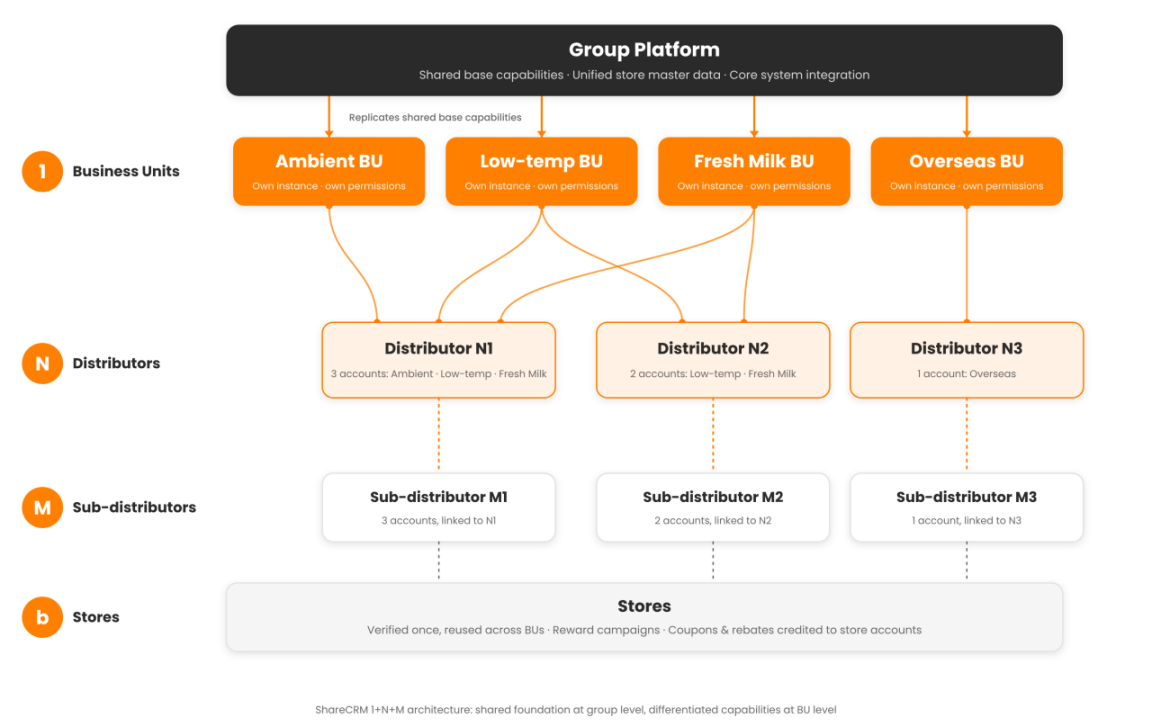
- • ◆ 1 — Business units. Each BU runs its own ShareCRM instance with independent permissions and a complete business loop. A group-level platform replicates shared base capabilities to every BU, and each BU adds only what is specific to its market.
- • ◆ N — Distributors. A distributor serving several BUs opens one account per BU. One distributor might hold three accounts for the ambient, low-temperature and fresh milk BUs, while another holds one for the overseas BU. Each BU sees only its own business, while the distributor stays connected to every parent company it serves.
- • ◆ M — Sub-distributors. The same model extends one level down to sub-distributors and store warehouses.
- • ◆ b — Stores. Stores sit at the end of the chain and take part directly, receiving reward campaigns and coupons or rebates credited to their accounts.
The foundation under this structure is a unified store management mechanism. A group-level store master record holds shared attributes, and each BU extends it with its own tags, grading rules and store attributes. A store is created and verified once, then reused across BUs. Store onboarding combines map-based point-of-interest data (global map data for the overseas BU, regional map data for the others) with duplicate checks and storefront photo verification, so new stores are added once and added correctly.
Differentiation does not require separate builds. Low-code configurators, such as a visit designer, an ordering designer and a TPM activity-type designer, let each BU tailor its own workflows, pages and rules on the shared foundation.
On top of this, the same platform supports the full channel workflow, designed to control goods, pricing and spend together:
- Store visits. Group, distributor and sub-distributor teams share visit tasks, corrective actions and approvals in one loop.
- Display and trade spend. Promotion plans from the TPM system and field execution results flow into one place, with AI-based display recognition checking shelf compliance from a photo.
- Goods flow. Distributors scan to receive and ship goods on mobile PDAs, and a unique-code-per-product system links stock movement to consumer promotions and traceability.
- Task incentives. Targets and reward rules are configured flexibly for each BU and channel.
The platform connects with SAP and the group's product, customer and personnel systems, so master data is maintained in one place and used everywhere.
The Results
The 1+N architecture is now live across Mengniu's channel, covering all business scenarios:
- • ✓ Multiple BUs, one platform. Liquid milk, low-temperature and fresh milk divisions operate on the same platform, with the overseas business supported by the same architecture.
- • ✓ Clear control at every tier. Group, BU and distributor roles and permissions are defined at each level, so every party sees the data it needs and group leadership gets a consistent view of channel performance instead of reconciling separate reports.
- • ✓ Sell-through in near real time. Sales data from more than 10,000 stores flows back to the platform within minutes, so teams plan replenishment and promotions on current data rather than delayed reports.
- • ✓ Bottle-level traceability. The logistics path of every bottle can be traced, supporting control of cross-region selling and code-based incentives.
- • ✓ A model that replicates. The low-temperature and fresh milk BUs were onboarded in phases using the liquid milk model. Because base capabilities are reused, each additional BU adds only its own differentiated needs, which keeps the cost of every new rollout lower than building a stand-alone system.
Next, Mengniu is piloting AI-assisted visit planning for field reps, extending the model to further BUs, and working toward a group-wide marketing platform with a unified data foundation.
Conclusion
Mengniu's project shows that a multi-BU group does not have to choose between standardization and autonomy. With a 1+N architecture, the shared foundation is built once and every BU runs on it in its own way.
Ready to run every business unit and channel partner on one platform?