Growth is rarely a straight line. For Ship Electronics, a global provider of digital communication and energy management solutions, the inflection point came in 2017 — when the company made a deliberate strategic shift away from its provincial exclusive-distributor model and began pushing deeper into city-level markets across its regions.
That decision unlocked significant commercial opportunity. It also multiplied operational complexity almost overnight.Ship Electronics operates three smart manufacturing bases across Asia — including facilities in Bangladesh — with sales offices and channel partners spanning 70+ countries. The company employs more than 4,000 people, including 500+ in R&D and technical support and 400+ international staff, delivering solutions across structured cabling, data center infrastructure, and commercial energy storage. With 30 years of industry experience, Ship had built significant scale. What it hadn't yet built was a CRM infrastructure capable of supporting that scale.
The Challenge
Ship had been running Salesforce for three years. As the channel expansion strategy accelerated, three problems moved from manageable to critical:
- Escalating costs. As Ship grew its distributor network to support city-level market penetration, Salesforce license costs scaled with it — creating mounting financial pressure that grew harder to justify with each new channel partner added.
- Poor workflow fit. Salesforce's interface and operational logic didn't fit the team's day-to-day working habits. Adoption was slow, usage was inconsistent, and the system required more effort than it was returning.
- Reliability issues. After Salesforce relocated its data center to Japan, Ship's teams experienced recurring outages and service interruptions — disrupting operations at exactly the moments when the business needed its systems to perform.
The business case for change was clear. What Ship needed was a platform built for the way its teams actually worked: flexible enough to handle complex channel structures, reliable enough to run without interruption, and cost-effective enough to scale without penalty.
The Solution
Ship Electronics selected ShareCRM following a structured evaluation process. The decision came down to three factors: the implementation team's deep understanding of Ship's business model, strong internal buy-in from sales leadership, and a product architecture purpose-built for the operational realities of high-tech B2B sales organizations.The project ran from May to November 2023, with full go-live achieved on schedule.
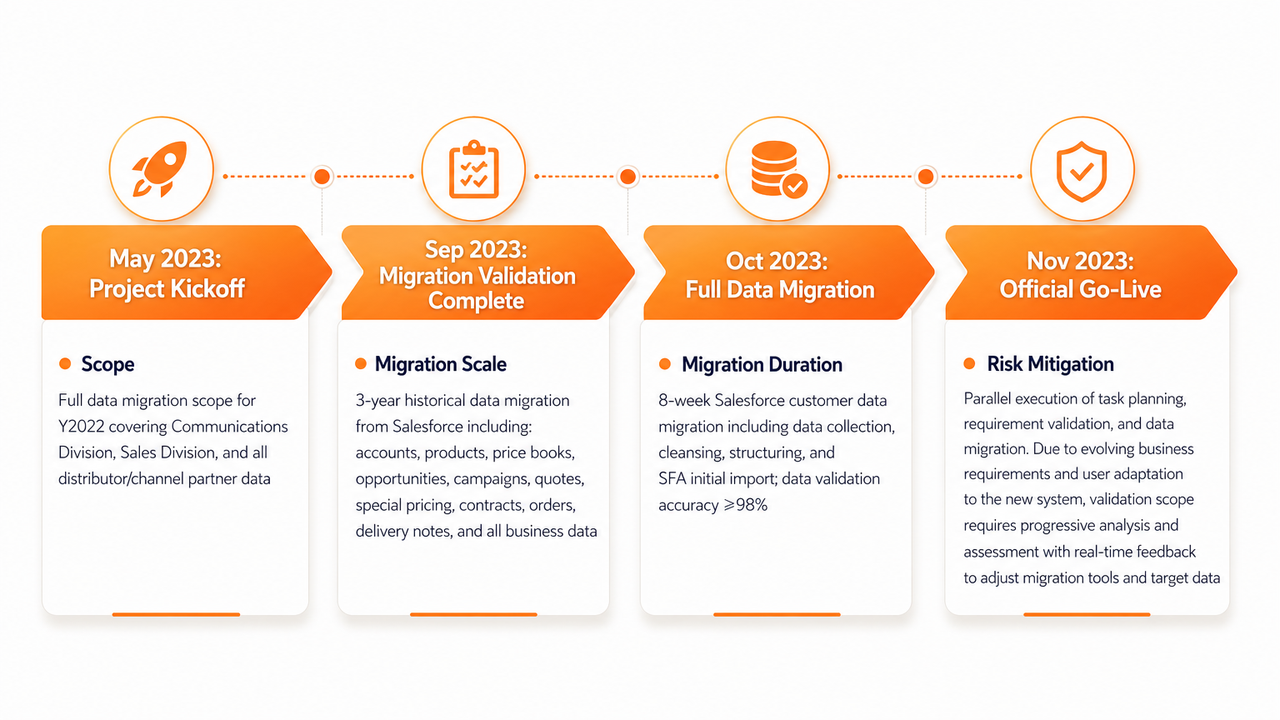
- Salesforce data migration. ShareCRM's implementation team executed a complete migration of three years of Salesforce data — covering customers, contacts, products, price lists, opportunities, pricing proposals, special price requests, contracts, orders, and shipping records. The migration was completed in 8 weeks, structured across three phases: validation (4 weeks of data collection, cleansing, and mapping), initialization (2 weeks), and verification and optimization (2 weeks).
- End-to-end pipeline digitization. Ship built a fully digital business operating loop within ShareCRM — covering the complete journey from lead through opportunity, special pricing, project registration, shipment management, and sales rep performance tracking. Process workflows now guide activity across every level of the channel hierarchy, reducing operational uncertainty and improving resource allocation.
- Channel and distributor management. ShareCRM enabled Ship to establish independent management structures for internal sales teams and external distributors — a critical requirement given the scale and diversity of its partner network. Distributors now operate within their own managed environment, with clear separation from direct sales workflows.
- Fuzzy search and data quality. A recurring issue with Salesforce had been the inability to handle fuzzy search effectively — a project with a slightly different name would register as a duplicate, creating data integrity problems across the pipeline. ShareCRM's fuzzy search capability was specifically validated during the selection process and has materially reduced back-office project management overhead since go-live.
The Result
- 100% Salesforce data migration success rate. Every record, relationship, and historical data point was successfully transferred — with data standards unified and upgraded across the organization in the process.
- $70,000+ USD in annual cost savings. Switching from Salesforce to ShareCRM reduced Ship's annual CRM spend by over $70,000 — covering both licensing fees and operational costs — directly relieving the financial pressure that had built as the channel network expanded.
- Zero data loss across three years of history. The migration covered all major business objects across Ship's two core business units and their associated distributor networks, preserving the full operational record.
- A platform built to scale. With ShareCRM's PaaS architecture, Ship now has a low-code customization layer that can adapt to future business changes — including the group-level consolidation structure needed to manage multiple business units under one platform as the company continues to grow globally.
Conclusion
Ship Electronics' migration from Salesforce to ShareCRM wasn't just a cost decision — it was a strategic reset of how the company manages its commercial operations at scale. With a platform that fits the team's workflow, eliminates downtime risk, and grows with the business, Ship now has the infrastructure its global ambitions require.Ready to make the switch from Salesforce — without the disruption? Talk to a ShareCRM Expert →