Why Enterprises Reevaluate Salesforce at Scale
For many enterprises, Salesforce has long been a reliable and capable CRM platform.
Its flexibility, rich ecosystem, and extensive customization options have helped organizations manage complex sales and customer operations across regions and teams.
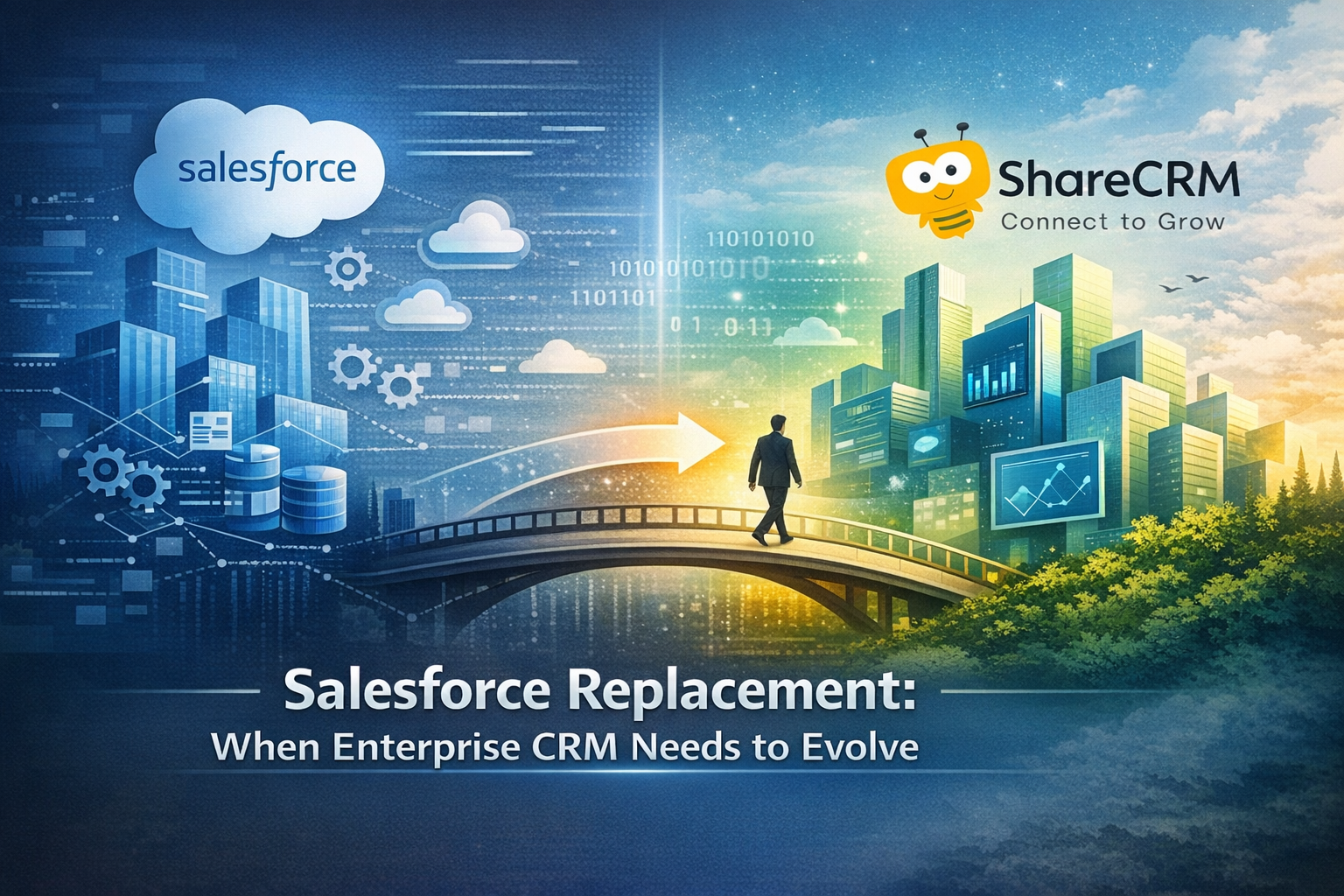
However, as enterprises grow in size, geography, and operational complexity, CRM requirements often change. What once enabled flexibility may gradually introduce higher costs, heavier customization, and increased operational overhead. At this stage, some organizations begin to reassess whether their CRM model still aligns with how they operate today.
Why Enterprises Choose ShareCRM
ShareCRM is designed for enterprises seeking a more predictable and operationally efficient CRM model.
Organizations typically consider ShareCRM when they want to:
- Improve cost transparency through a unified licensing and delivery model
- Operate CRM on a single, unified platform instead of fragmented clouds
- Work with delivery teams that have extensive Salesforce replacement experience
- Maintain enterprise-grade security and compliance, including GDPR and ISO standards
The objective is not feature-by-feature replication of Salesforce.
Instead, ShareCRM focuses on supporting core enterprise workflows with lower long-term operational friction and clearer governance.
How Salesforce Replacement Is Executed
Replacing Salesforce is not a simple platform switch.
It is a structured transformation of how CRM supports business processes, data governance, and organizational workflows.
Enterprises that successfully replace Salesforce typically follow a phased and controlled approach, rather than attempting a one-time cutover:
Gap Analysis & Planning
Assess the current Salesforce landscape, define migration scope, and establish a target CRM blueprint.
System Migration
Automate the migration of core objects, fields, and business data via connectors, while redesigning workflows, approvals, and process logic based on customer-specific requirements.
User Acceptance Testing
Validate key business scenarios, reconcile migrated data, and ensure continuity across critical workflows.
Go-Live & Rollout
Execute controlled cutover, enable users, and support phased rollout with post-launch stabilization.
This approach emphasizes risk control, continuity, and predictability, ensuring that CRM replacement supports ongoing business operations rather than disrupting them.
What Enterprises Typically Gain After Replacement
Across real enterprise migration projects, organizations adopting ShareCRM typically experience greater cost transparency, improved operational control, and more manageable CRM operations.
By consolidating workflows on a unified platform and shifting from custom-heavy implementations to configuration-driven operations, enterprises are able to simplify system management while maintaining stability and compliance. Automated migration of core data, combined with customer-specific process redesign, enables organizations to move forward without compromising business continuity.
These outcomes are supported by experience from 100+ successful enterprise Salesforce replacement projects, across industries and regions.
Replacement Is About Alignment, Not Superiority
Salesforce, ShareCRM, and other CRM platforms serve different organizational needs and operating models.
For enterprises navigating growth, regional expansion, or rising operational complexity, CRM replacement is rarely about finding a “better” platform. More often, it is about finding a platform that is better aligned with how the organization operates today—and how it plans to operate in the future.
Understanding when and how to evolve the CRM model is a critical step toward long-term operational efficiency.