Why First Contact Resolution Matters More Than Ever
Support teams today face a difficult reality: customer expectations are rising, ticket volumes continue to grow, but headcount and budgets remain limited. Leaders are under constant pressure to improve key service metrics—especially First Contact Resolution (FCR)—without expanding their teams.
This is where AI triage changes the game.
More and more organizations are turning to AI not just to save time, but to fundamentally improve how support operates. By combining automation with smarter routing and better context for agents, teams are finding new ways to meet service targets, strengthen customer experience, and deliver better outcomes—without increasing headcount.
The shift is clear: AI is no longer just a tool for efficiency. It is becoming a strategic driver of service quality and performance.
What Is AI Triage in Customer Support?
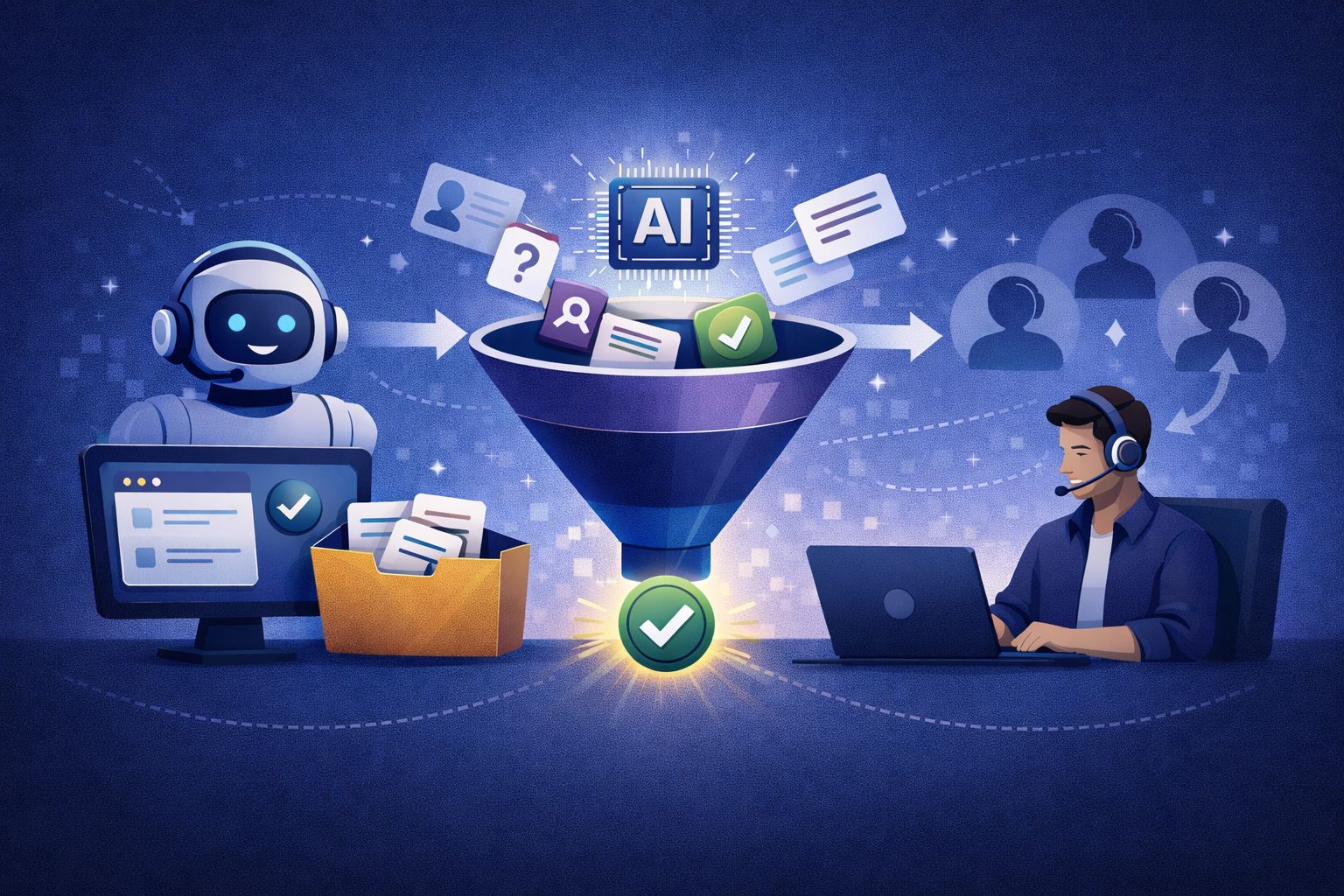
AI triage is the use of artificial intelligence to automatically assess, categorize, and route incoming support requests. Instead of every ticket going through the same manual process, AI analyzes intent, urgency, and context to decide:
- Which issues can be resolved instantly
- Which need human attention
- Which specialist or team should handle them
- What information should be prepared before escalation
In modern help desks, AI triage works alongside tools like chatbots, knowledge bases, and agent-assist features—creating a smarter, faster, and more efficient support flow.
How AI Triage Directly Improves FCR
First Contact Resolution improves when customers get the right answer the first time—without transfers, delays, or repeated explanations. AI triage boosts FCR in four powerful ways.
1. Faster, Smarter First Responses
AI-powered chatbots handle common questions instantly, providing accurate, contextual answers. Many routine issues—password resets, billing queries, account changes—are resolved before a human agent is even involved.
When escalation is needed, AI gathers key details upfront, so agents don’t waste time asking basic questions. That means fewer back-and-forths and higher chances of resolving the issue in one interaction.
2. Better Handoffs, Less Repetition
One of the biggest enemies of FCR is poor handoff. Customers hate repeating themselves.
AI triage solves this by:
- Summarizing conversations automatically
- Passing full context to agents
- Highlighting intent, sentiment, and urgency
Agents start every case informed—so solutions come faster and with fewer misunderstandings.
3. More Human Time for High-Impact Issues
By handling repetitive work, AI frees agents to focus on problems that require empathy, judgment, and creativity. Support teams spend less time on basic tickets and more time solving complex cases properly the first time—exactly what FCR depends on.
4. Consistent Quality at Scale
AI tools help agents write better responses faster. Features like tone adjustment, text expansion, and rephrasing ensure replies stay clear, professional, and customer-friendly—even during peak volumes. Consistency improves trust, and trust improves resolution success.
Why AI Triage Improves Productivity Without Adding Headcount
AI triage doesn’t replace people—it multiplies their impact.
Support leaders report three major productivity gains:
Fewer Manual Tasks
AI handles:
- Ticket categorization
- Conversation summaries
- Routing and prioritization
- Drafting responses
This removes hours of repetitive work from every agent’s week.
Lower Customer Effort
Customer Effort Score (CES) improves when issues are resolved quickly and smoothly. AI reduces friction by offering instant answers, guiding users to self-service, and ensuring fast escalation when needed. According to 2023 data, 39% of leaders believe AI directly reduces customer effort.
Higher Customer Satisfaction
Faster responses, fewer transfers, and better communication all lead to better CSAT. As AI becomes more embedded in support operations, more leaders expect measurable gains in satisfaction and loyalty.
Key Metrics That AI Triage Helps Improve
AI-driven help desks consistently improve three critical support KPIs:
Time to Resolution
AI speeds up case handling by resolving simple issues instantly and accelerating complex ones through better preparation and routing.
Customer Effort Score (CES)
Customers spend less time searching, waiting, and repeating themselves.
Customer Satisfaction (CSAT)
Clear communication, faster outcomes, and more consistent service lead to higher satisfaction scores.Together, these improvements translate into better FCR—and stronger overall service performance.
Best Practices for Implementing AI Triage
1. Adopt a Continuous Improvement Mindset
AI evolves fast. Teams that succeed treat AI triage as an ongoing optimization—not a one-time project. Regularly review workflows, performance data, and customer feedback to keep improving.
2. Learn to Work With Technology
The most successful teams don’t fear AI—they learn how to use it effectively. When agents understand how AI supports them, adoption rises and results follow.
3. Use Data to Guide Decisions
AI help desks generate valuable insights:
- What customers ask most
- Where escalations happen
- Which issues AI resolves best
Use this data to refine training, knowledge bases, and service design.
Real-World Impact
Many organizations already see the value of AI triage in daily operations. From faster response drafting to instant conversation summaries, support leaders consistently report:
- Less workload pressure
- Better agent focus
- Higher service consistency
- Improved customer experience
The result is not just efficiency—but scalable excellence.
In Summary
Improving First Contact Resolution no longer requires hiring more agents or stretching teams thinner. With AI triage, support organizations can resolve more issues on the first interaction by working smarter—not harder.
By automating classification, accelerating responses, reducing manual work, and giving agents better context, AI triage transforms support into a high-performance operation. Customers get faster answers. Agents stay focused on meaningful work. Leaders hit productivity and growth goals—without adding headcount.
For modern support teams, AI triage isn’t just a tool. It’s becoming the foundation of scalable, customer-centric service.