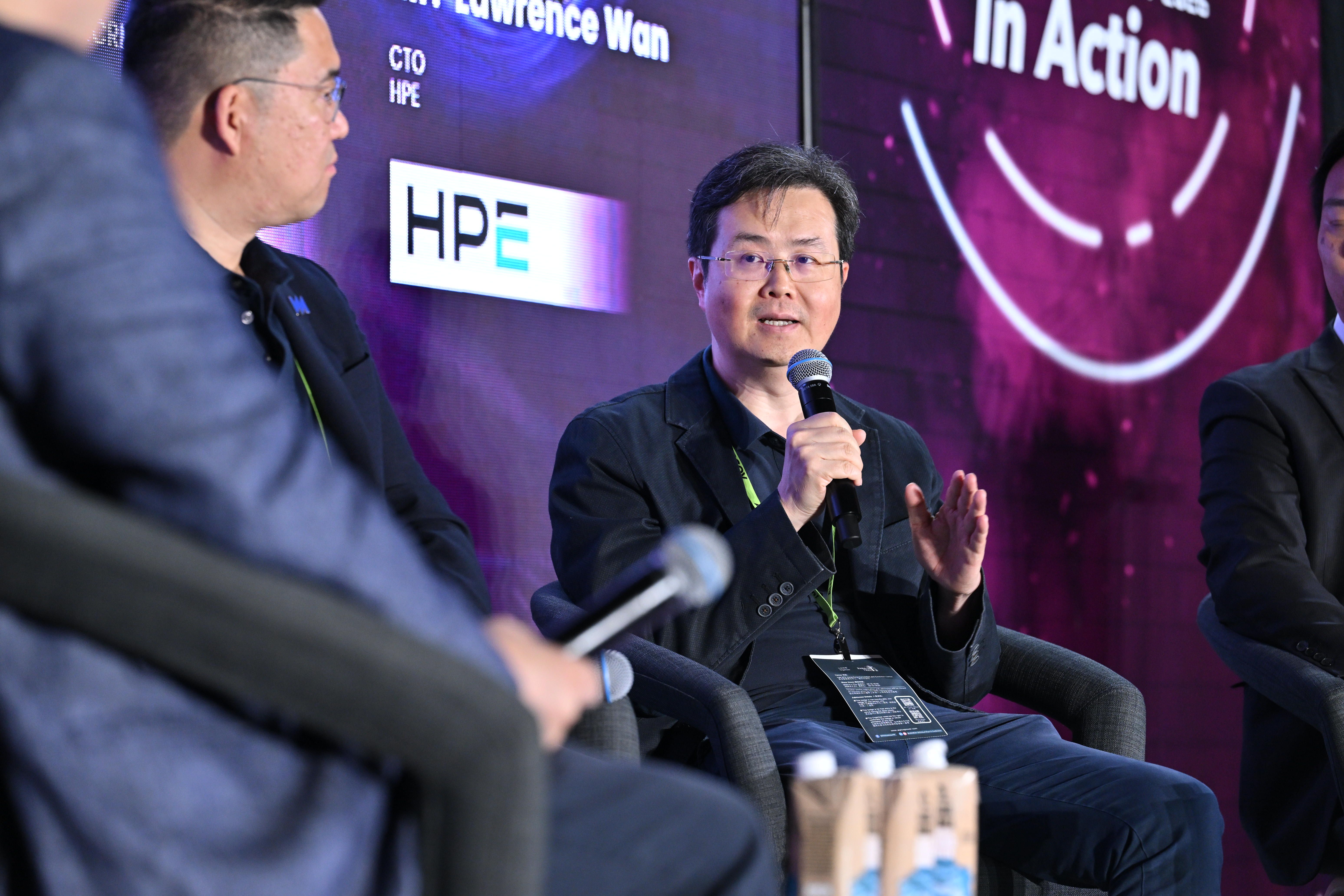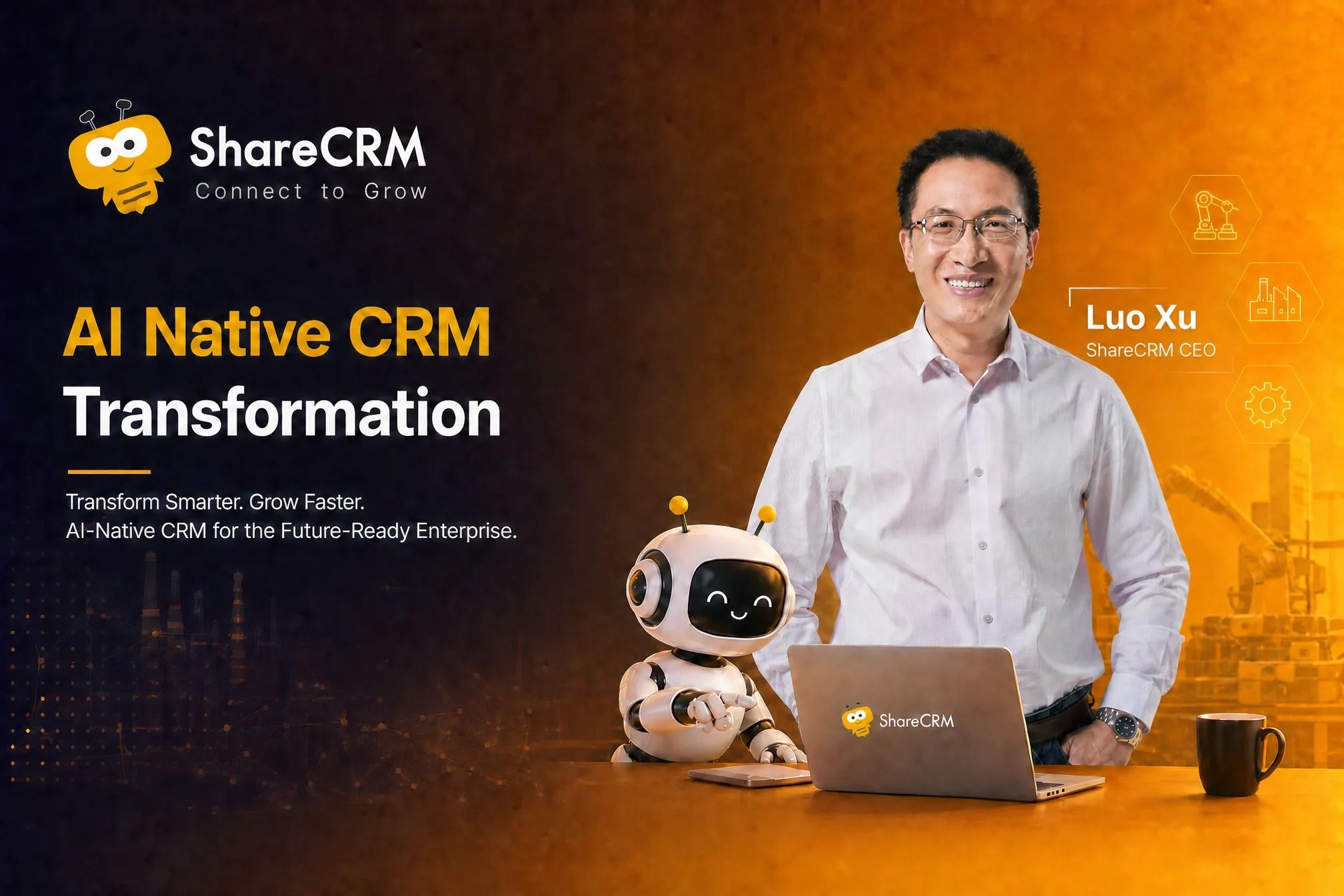
TL;DR:At a recent international executive summit, ShareCRM CEO Luo Xu shared a comprehensive methodology for enterprise AI transformation, emphasizing that true productivity breakthroughs require businesses to restructure organizational frameworks rather than just deploying isolated software tools.
Introduction
The rapid proliferation of artificial intelligence across corporate software ecosystems has created an unexpected operational paradox for modern B2B leaders. While individual software tools have advanced dramatically, many multinational organizations are finding that their aggregate operational output remains completely unchanged. As an international pioneer with over 13 years of enterprise CRM experience, delivering trusted technological pillars is vital for long-term global competitiveness. Speaking at a dedicated online leadership forum focused on cross-border business evolution, ShareCRM CEO Luo Xu provided a clear diagnostic roadmap for overcoming modern adoption barriers.
The Productivity Paradox: Why Advanced Tools Fail to Scale
The primary obstacle preventing modern organizations from achieving exponential performance gains is not a limitation of technology itself, but an outdated alignment of corporate structures. Many business decision-makers mistakenly assume that increasing individual software spending automatically translates into corporate-wide efficiency gains. In practice, inserting sophisticated machine learning components directly into legacy operational flows creates friction, leaving new capabilities entirely constrained by old administrative boundaries.
This sharp divergence between tool acquisition and actual corporate value is heavily documented across modern software research. According to specialized benchmark statistics published in the global AI Adoption in Business Analysis, while 88% of global organizations have now initiated artificial intelligence tools within their business functions, a mere 1% of enterprise leaders describe their rollouts as mature enough to be fully optimized.
Furthermore, detailed technological tracking from the Master of Code GenAI Report indicates that only 23% of surveyed businesses have successfully achieved functional scale within a single department, and a tiny fraction (7%) have fully scaled them across the enterprise. As Luo Xu noted during his keynote address: "Many enterprises are desperately using AI tools, but very few are actually governing their core business data and workflows."
Shifting from AI Enhancement to AI Native: Redefining the Operating Model
To break through this structural bottleneck, global enterprises must transition away from simple "AI enhancement" and completely embrace an "AI Native" operational philosophy. This shift fundamentally redefines the relationship between corporate personnel, workflows, and communication channels. Traditional models rely heavily on linear steps and manual handoffs. Conversely, an optimized AI Native infrastructure operates as a fluid, flattened collaborative network centered around human-AI orchestration.
Luo Xu outlined four core organizational characteristics that define successful AI Native transformation:
- High Talent Density: Cultivating lean, highly specialized teams where individuals leverage automation to expand their total strategic output tenfold.
- Ultra-Short Decision Pathways: Drastically flattening traditional management hierarchies to accelerate corporate reaction time.
- High Tolerance for Innovation-Driven Iteration: Building agile frameworks that can rapidly test and deploy multiple automated workflows to find optimal paths.
- Minimal Coordination Overhead: Transitioning corporate structures into highly autonomous, results-oriented execution units.
"AI is not merely a tool; it is becoming the new corporate operating system," Luo Xu emphasized. "Therefore, AI transformation is not a technical upgrade, but a fundamental reconstruction of business and organizational models."
A Pragmatic Five-Step Path to Business Re-engineering
To assist global manufacturing and industrial organizations in navigating this transition, ShareCRM leverages an implementation blueprint focused on shifting execution from "process-driven" to "results-driven" automation:
- Isolate High-Frequency Tasks: Prioritize daily recurring business activities with highly measurable outcomes as initial testing grounds.
- Redefine the Core Workflow: Break down major corporate goals into smaller, machine-executable actions so human operators can focus entirely on strategic decision-making.
- Reconstruct Team Structures: Modify standard human-to-human workflows into human-to-agent collaborative networks.
- Establish Clear Measurement Systems: Build robust evaluation frameworks to score agent outputs and establish exact quality baselines.
- Anchor Specialized Knowledge Engineering: Direct top domain experts to train internal models on real business decision logic rather than simply uploading unorganized documents.
Perspective: Redefining Production Relations
The ultimate success of this five-step blueprint relies on a profound cultural reset regarding how leadership views human talent. Far too many organizations treat advanced software as a tool for immediate, aggressive downsizing. ShareCRM’s philosophy, backed by our extensive track record of serving over 6,000 corporate customers globally, rejects this shortsighted view.
Forward-thinking executives understand that while an AI model can elevate the minimum baseline of corporate efficiency, the upper limits of business innovation will always be defined by human creativity.
"AI redefines production relations; it is not about the blunt elimination of jobs," Luo Xu concluded. "True visionary leaders do not focus on how to cut staff. They focus on how to reallocate employees—freed from repetitive manual tasks by AI—into strategic areas that generate significantly higher value for the end customer."
Conclusion
The ultimate boundary of a modern intelligent enterprise is never determined by software constraints, but by leadership perspective. By transitioning to an AI Native operational framework, international organizations can systematically lower coordination friction while unlocking massive commercial potential. To explore how our integrated CRM solutions and specialized ShareAI frameworks can accelerate your organization's intelligence turn, contact a ShareCRM advisor today to get started.